

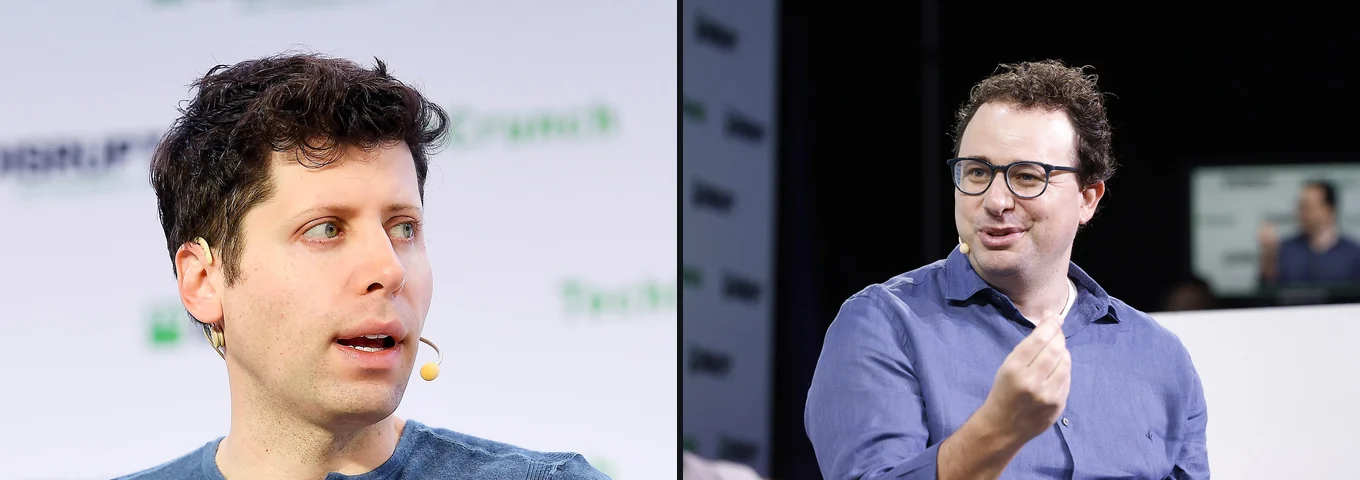
Where do Sam Altman and Dario Amodei agree and disagree?
Dario Amodei asked the AI industry to slow down on 12 September 2026, and Sam Altman agreed the same day. "I agree with Dario that we need to pace the frontier," Altman wrote on X. Three weeks later he told Politico the world should "accept some bad things happening for the benefits of this technology," so the two still part ways on how much risk to take. The orange dots mark the two days they took the same side in public.
Their rivalry goes back to their years together at OpenAI, and since February 2026 it has played out in public, over Super Bowl ads and the Pentagon. We read each man's essays, posts, Senate testimony and interviews from May 2023 to October 2026, then matched them topic by topic. Every quote is the named person's own words, with one exception: Anthropic's ad pledge was a company post, and the row says so. Dates are the day each line was published or said. Split means the record backs part agreement, or one man never named the other, so a flat verdict would overstate it.
| Topic | Sam Altman (OpenAI) | Dario Amodei (Anthropic) | Verdict |
|---|---|---|---|
| Extinction risk | Signed "Mitigating the risk of extinction from AI should be a global priority" (30 May 2023) | Signed the same statement (30 May 2023) | Agree |
| Pacing the frontier | "I agree with Dario that we need to pace the frontier" (X, 12 Sep 2026) | "We must slow the pace at which we improve the capabilities of AI models" (essay, 12 Sep 2026) | Agree |
| When powerful AI arrives | "2026 will likely see the arrival of systems that can figure out novel insights" (blog, 10 Jun 2025) | "I think it could come as early as 2026" (essay, Oct 2024) | Split |
| Binding regulation | Wants "one federal framework that is light touch" (Senate, 8 May 2025) | "It is time to go beyond transparency to more serious and binding regulation of AI" (essay, Jun 2026) | Disagree |
| State AI laws | "it is very difficult to imagine us figuring out how to comply with 50 different sets of regulation" (Senate, 8 May 2025) | "the right place to start is with transparency legislation," citing California's SB 53 (essay, Jan 2026) | Disagree |
| Export controls on China | Doubts they work: "My instinct is that doesn't work" (asked about cutting GPU supplies to China, 18 Aug 2025) | Wants them kept: "Do not sell powerful AI chips or semiconductor manufacturing equipment to China" (essay, 12 Sep 2026) | Disagree |
| Open weights | "if we didn't do it, the world was gonna head to be mostly built on Chinese open source models" (18 Aug 2025) | "Anthropic has never advocated for a ban on open-weights models" (27 Jul 2026), but ships none | Split |
| Ads in chatbots | "I wonder why Anthropic would go for something so clearly dishonest" (X, 4 Feb 2026) | Anthropic, not Amodei: "Claude will remain ad-free" (4 Feb 2026) | Disagree |
| Office jobs | "I'm delighted to be wrong about this" (26 May 2026) | AI "could displace half of all entry-level white collar jobs" (essay, Jan 2026) | Disagree |
| Compute spending | "commitments of about $1.4 trillion over the next 8 years" (X, 6 Nov 2025) | "some players who are 'YOLO-ing,' who pull the risk dial too far" (DealBook, 3 Dec 2025; named no company) | Split |
| Pentagon work | "Tonight, we reached an agreement with the Department of War" (X, 27 Feb 2026) | "we cannot in good conscience accede to their request" (26 Feb 2026) | Split |
They agree on 2 of the 11 and disagree on 5. Both agreements are about danger: extinction risk and the need to pace the frontier. On timing, Altman's 2026 forecast is for systems that find novel insights. That's a narrower claim than Amodei's powerful AI, so the row is a split. The five disagreements are about what to do next. On open weights and the Pentagon, they name the same limits and still made opposite calls. On compute, Amodei warned about reckless spending but named no company. Each man's forecast record has its own page: Sam Altman's AGI predictions and Dario Amodei's predictions.
Altman backed the pacing plan within hours, then drew his own line
Altman signed on to the first step of Amodei's pacing plan the day it came out. Amodei's essay, We Must Pace the Frontier, has three steps. Each frontier lab gives outside evaluators "ongoing, employee-like access." Labs in democratic countries agree on common safety standards. Then the US and its allies try to coordinate with authoritarian governments, China included. Anthropic says it is committing to the first step on its own.
Altman took it too. "Committing to having independent evaluators with employee-like access is a great idea, and we will do the same," he wrote, as CNBC reported. Elon Musk posted "Dario is right." That same day, Altman told Fortune an OpenAI IPO this year would be "ill-advised."
The agreement has an edge, though. In the Politico interview that Fortune reported on 5 October, Altman put his limit at the far end: "But don't accept, like, the really catastrophic risk." Below that line, he'd take the trade. Amodei's June essay asks for government power to block a dangerous model before it ships.
Why do Altman and Amodei disagree on AI regulation?
They disagree because Altman wants one light federal law and Amodei wants binding tests now, with states acting if Congress won't. At a Senate hearing on 8 May 2025, Altman said "it is very difficult to imagine us figuring out how to comply with 50 different sets of regulation," according to the Tech Policy Press transcript. Anthropic endorsed California's SB 53 on 8 September 2025. It still said it would prefer a federal rule.
Amodei went further in June 2026. His essay Policy on the AI Exponential models AI rules on the Federal Aviation Administration: "Models above a threshold of compute should undergo mandatory testing by a qualified third party." Altman hasn't backed anything like it.
Money sits behind both sides. Anthropic gave $20 million to Public First Action on 12 February 2026, a group backing candidates who want AI safeguards. Axios reported that the rival super PAC, Leading the Future, had raised over $125 million from OpenAI president Greg Brockman, a16z and others. Altman has gone after the safety message itself, too. On the Core Memory podcast in April 2026, he said "fear-based marketing is probably the most effective way to justify that," meaning AI kept in fewer hands, Decrypt reported.
Do Altman and Amodei agree on China and chip exports?
No. Amodei wants export controls on China kept and tightened, and Altman doubts they work. Asked in August 2025 whether cutting GPU supplies to China would help, Altman said "My instinct is that doesn't work," CNBC reported. "You can export-control one thing, but maybe not the right thing," he added.
Amodei went the other way at Davos on 20 January 2026. He compared selling Nvidia chips to China to "selling nuclear weapons to North Korea," TechCrunch reported. His September essay repeats it as a rule: "Do not sell powerful AI chips or semiconductor manufacturing equipment to China."
China also explains their split on open weights. In a Reddit AMA on 31 January 2025, Altman wrote that OpenAI had been "on the wrong side of history" on open source, TechCrunch reported. He later said Chinese models pushed OpenAI to release its own open weight models in August 2025. Anthropic hasn't released any. Still, Amodei wrote on 27 July 2026 that "Anthropic has never advocated for a ban on open-weights models", and he called the safe ones "a public good." He wants every capable model tested, open or closed.
What happened between Altman and Amodei over the Pentagon?
Anthropic refused the Pentagon's terms on 26 February 2026, and OpenAI announced its own deal the next night. Amodei's statement drew two red lines: mass domestic surveillance and fully autonomous weapons. "These threats do not change our position: we cannot in good conscience accede to their request," he wrote. On 27 February, Altman posted that OpenAI had reached an agreement with the Department of War. He listed the same two limits as OpenAI principles, Newsweek reported.
Then it got personal. An internal Amodei memo, leaked to The Information, called Altman's public statements "straight up lies." On 3 March, Altman said OpenAI's rush to sign looked "opportunistic and sloppy," Bloomberg Law reported. By 6 March the Pentagon had formally labeled Anthropic a supply chain risk. Amodei apologized "for the tone" of the memo, Fortune reported. On 1 October, Trump said of Amodei, "I liked him and his wife a lot," Bloomberg reported.
Why did Altman call Anthropic's Super Bowl ads dishonest?
Altman called them dishonest because they showed chatbots slipping sales pitches into private chats, which he said OpenAI's ad rules forbid. Anthropic posted on 4 February 2026: "So we've made a choice: Claude will remain ad-free." Its Super Bowl spots showed assistants turning personal talks into pitches.
Altman replied on X the same day. "First, the good part of the Anthropic ads: they are funny, and I laughed," he wrote. Then: "But I wonder why Anthropic would go for something so clearly dishonest." He added that Anthropic "serves an expensive product to rich people" and that "One authoritarian company won't get us there on their own," TechCrunch reported. We found no public reply from Amodei himself. This is the one row where his company speaks for him.
Will AI take junior office jobs? Altman now says he was wrong
Both men expected AI to cut junior office jobs fast, and Altman now says it hasn't happened. In The Gentle Singularity in June 2025, he wrote about "whole classes of jobs going away." Amodei's January 2026 essay, The Adolescence of Technology, restated his forecast that AI "could displace half of all entry-level white collar jobs" within one to five years.
On 26 May 2026, Altman told Commonwealth Bank's Matt Comyn: "I'm delighted to be wrong about this." He'd expected more of those jobs to be gone by now, Reuters reported. Amodei's June essay still calls "enduring job displacement" something "undesirable and dangerous." Our AI job loss statistics count the cuts US employers have blamed on AI so far.
Amodei warned about huge compute bets without naming OpenAI
Amodei thinks some rivals are betting too much on data centers, though he didn't name a company. On 6 November 2025, Altman wrote on X that OpenAI was "looking at commitments of about $1.4 trillion over the next 8 years," TechCrunch reported. Four weeks later, at the New York Times DealBook Summit, Amodei said: "there are some players who are 'YOLO-ing,' who pull the risk dial too far, and I'm very concerned," TechCrunch reported.
Do Sam Altman and Dario Amodei get along?
Not in public. Amodei joined OpenAI in 2016 and rose to vice president of research. He left at the end of 2020 with his sister Daniela and founded Anthropic in 2021. The rift dates from those years. In April 2026, The New Yorker reported that Amodei's private notes from his OpenAI time concluded "The problem with OpenAI is Sam himself." In a blog post on 10 April 2026, Altman called it "an incendiary article," TechCrunch reported. Our piece on why Dario Amodei left OpenAI has the full story.
At India's AI Impact Summit on 19 February 2026, Narendra Modi asked the CEOs on stage to join hands. Everyone did except Altman and Amodei, who stood side by side, TechCrunch reported. In June, Amodei told Bloomberg the summit was "extremely disorganised," Business Standard reported. Yet in May 2023 they both signed the one sentence neither has disputed since: "Mitigating the risk of extinction from AI should be a global priority alongside other societal-scale risks such as pandemics and nuclear war." It's on the Center for AI Safety's site, with both names on it.
- Check the date on any Altman or Amodei quote, because Altman changed his view on jobs and open weights within about a year
- Separate the man from the company: the ad pledge and the SB 53 endorsement were Anthropic posts, not Amodei bylines
- Read the leaked Amodei memo as reported by The Information, not as a published statement
- Look for the condition in Altman's support for pacing: it stops at "really catastrophic risk"
Frequently asked questions
Is Sam Altman for or against slowing down AI?
Altman is for pacing the frontier and against blocking every risk. On 12 September 2026 he wrote "I agree with Dario that we need to pace the frontier" and promised outside evaluators. In October he said the world should accept bounded risks for the benefits, and draw the line at catastrophic ones.
Did Dario Amodei work for Sam Altman?
Yes, for about two years. Amodei joined OpenAI in 2016, and Altman became its CEO in 2019. Amodei left at the end of 2020 as vice president of research and founded Anthropic in 2021 with his sister Daniela.
Who is richer, Sam Altman or Dario Amodei?
Dario Amodei is richer. Forbes put his net worth at $15.5 billion on 22 October 2026, against $3.2 billion for Altman. Forbes says Altman "has no equity in OpenAI" and made his money from stakes in companies such as Stripe, Reddit and Helion. AI company CEOs sets them beside the other lab leaders.
Why didn't Altman and Amodei hold hands at the India AI summit?
Neither has called it a snub. When Narendra Modi asked the CEOs on stage to join hands on 19 February 2026, Altman and Amodei kept theirs apart. Amodei later told Bloomberg the event was "extremely disorganised" and blamed last minute changes to where people stood.


