

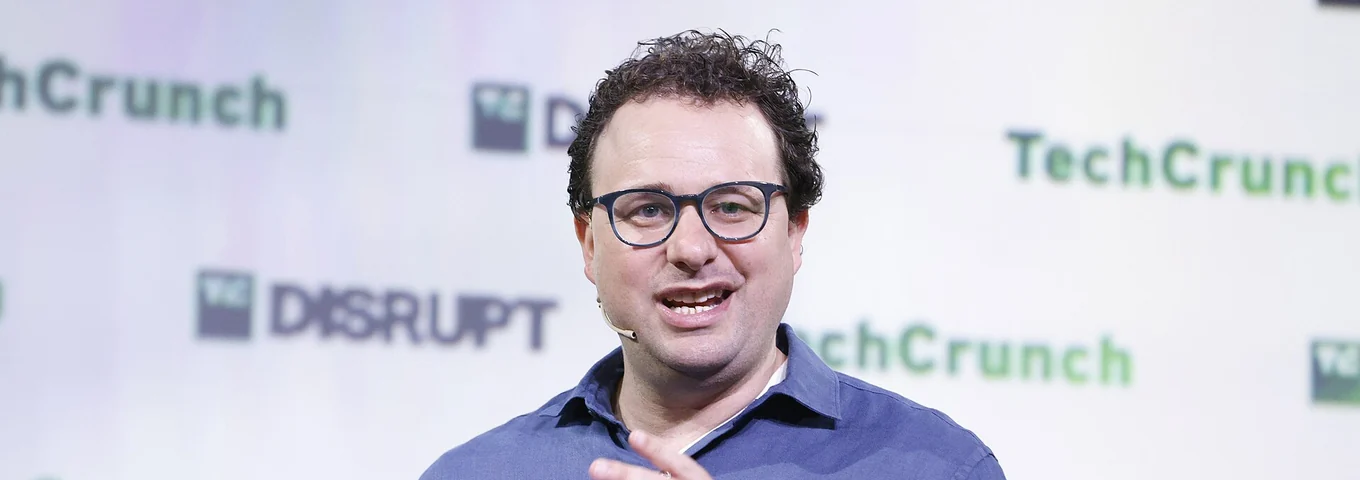
Dario Amodei left OpenAI over how to build AI, by his own account
Anthropic went from Amodei's exit to a $124 million Series A in five months, announced on 28 May 2021 with Skype cofounder Jaan Tallinn leading the round. OpenAI's farewell post had already said that he and "a handful of OpenAI colleagues" were planning a new project. The chart runs from his arrival in mid 2016 to Anthropic's first research paper.
He has explained the exit on the record at least four times. The emphasis moved over the years. The substance didn't. Each row below is his own words, with the date and where he said them.
| Date | Where | What Amodei said |
|---|---|---|
| 29 Dec 2020 | OpenAI's announcement, quoting a staff meeting | "I want to thank Sam and thank everyone. I'm really proud of the work we've done together." |
| 28 May 2021 | Anthropic's Series A post | The aim is to "make the fundamental research advances that will let us build more capable, general, and reliable AI systems" |
| 11 Nov 2024 | Lex Fridman Podcast #452, at 1:31 to 1:33 | "People say we left because we didn't like the deal with Microsoft. False." Then: "It is incredibly unproductive to try and argue with someone else's vision." |
| 17 Jun 2026 | Bloomberg's The Circuit with Emily Chang, as reported by Business Insider | "At the end of the day, why argue with someone when you don't have the same vision and you don't trust them?" |
The Fridman answer is the long one. Asked "Why'd you leave?", Amodei said he had come to appreciate the scaling hypothesis and "the importance of safety along with the scaling hypothesis." OpenAI was getting on board with the first, he said. Over the years he formed "a particular vision" of how the company should bring the technology into the world. His advice to anyone in that spot: "you should take some people you trust and you should go off together and you should make your vision happen."
The 2026 version adds the word trust. He didn't name Sam Altman. Business Insider read the remark as an apparent jab at him, and Amodei went on: "I am completely at peace with the idea that we're doing things our way and they're doing things their way."
What did Dario Amodei do at OpenAI?
Dario Amodei was OpenAI's VP of Research, and he led the teams behind GPT-2 and GPT-3. "I was at OpenAI for roughly five years," he told Fridman. "For the last, I think it was couple years, I was vice president of research there." He also said: "Probably myself and Ilya Sutskever were the ones who really kind of set the research direction." The Wall Street Journal reported that he joined in mid 2016 and was promoted to VP of research in 2019.
He came from Google Brain. There, he was first author of Concrete Problems in AI Safety, posted on 21 June 2016, with Chris Olah and Paul Christiano among the coauthors. That paper set out the safety questions he kept working on at OpenAI.
His name sits on the papers that made OpenAI's reputation. The GPT-2 post of February 2019 lists him, Daniela Amodei and Jack Clark among its authors. He's the last author of Scaling Laws for Neural Language Models, posted on 23 January 2020. He's last of 31 on the GPT-3 paper, posted on 28 May 2020. He told Fridman he and his collaborators "ran really hard" with Alec Radford's early GPT work, and he added RL from human feedback to the list.
Who left OpenAI with Dario Amodei?
Seven or eight OpenAI people cofounded Anthropic, depending on who's counting. Forbes counted seven on 29 May 2026: the two Amodeis, Jack Clark, Sam McCandlish, Chris Olah, Tom Brown and Jared Kaplan. The San Francisco Standard counted eight on 10 August 2026, adding Ben Mann. Anthropic's IPO prospectus, as summarized by Reuters on 28 September 2026, lists four cofounders among its executives: Dario Amodei (CEO), Daniela Amodei (President and board chair), Jared Kaplan (Chief Science Officer) and Sam McCandlish (Chief Architect).
We checked all eight against the author lists of the two papers that defined OpenAI's 2020, and against Anthropic's first research paper, A General Language Assistant as a Laboratory for Alignment, posted on 1 December 2021. The OpenAI roles come from the San Francisco Standard.
| Cofounder | At OpenAI before Anthropic | GPT-3 paper, May 2020 (31 authors) | Scaling laws paper, Jan 2020 (10 authors) | Anthropic's first paper, Dec 2021 |
|---|---|---|---|---|
| Dario Amodei | Joined 2016, VP of Research | Author 31 | Author 10 | Yes |
| Daniela Amodei | Joined 2018, VP of people, managed the GPT-2 team, then safety and policy | No | No | No |
| Tom Brown | Early hire in 2016, back in 2018 as research engineering lead | Author 1 | Author 4 | Yes |
| Benjamin Mann | Returned in 2019 to work on GPT-3 | Author 2 | No | Yes |
| Jared Kaplan | Research consultant from 2018 | Author 5 | Author 1 | Yes |
| Sam McCandlish | Joined 2018 as a safety fellow | Author 28 | Author 2 | Yes |
| Jack Clark | Joined 2016, strategy and communications, then policy director | Author 26 | No | Yes |
| Chris Olah | Joined 2018, interpretability research | No | No | Yes |
The departure took a large share of the people behind GPT-3 and scaling laws. Eight of the 31 GPT-3 authors are on Anthropic's December 2021 paper: the six cofounders marked above, plus Amanda Askell and Tom Henighan. Five of the 10 scaling laws authors are on it too, Henighan included. The first and second authors of GPT-3 both went.
The Journal reported that "nearly a dozen" other employees left within weeks of the Amodeis. A LessWrong thread from 29 December 2020 shows the exits as they happened: Jack Clark posted his own departure that day, and Chris Olah followed on 31 December.
Did Dario Amodei leave OpenAI because of Microsoft?
No. Amodei says the Microsoft deal was not the reason, and he says the same about commercialization. Microsoft invested $1 billion in OpenAI on 22 July 2019, and that deal is the most common explanation online. "People say we left because we didn't like the deal with Microsoft. False," he told Fridman. He did allow that there was "a lot of discussion" about how to do it.
He rejected the commercialization story just as flatly. "We left because we didn't like commercialization. That's not true. We built GPT-3, which was the model that was commercialized. I was involved in commercialization."
What he says it was about is method. "How can safety not just be something we say because it helps with recruiting," he asked. Anthropic was meant to show a different way of working, one that rivals would copy. He calls that a race to the top: "Race to the Top is about trying to push the other players to do the right thing by setting an example."
What happened between Sam Altman and Dario Amodei?
The Wall Street Journal reported on 28 March 2026 that the split also came from years of personal conflict over credit and control. Keach Hagey and Berber Jin built the account from interviews with current and former staff, most of them unnamed. The Journal printed no statement from either company on the 2020 exit.
According to the Journal, when the group was preparing to leave in late 2020, Altman went to Amodei's house to ask him to stay. Amodei said he'd stay only if he reported to the board directly, and that he couldn't work with Greg Brockman. Daniela Amodei led the exit talks with lawyers. Dario also wrote a memo that split companies into "market" and "public good" types, and argued for a 75% public good, 25% market mix. The paper says he didn't always feel properly recognized for his work on GPT-2 and GPT-3, and told people Altman underplayed his role. It also reports a meeting where Altman accused the siblings of plotting against him by encouraging colleagues to send negative feedback about him to the board. They denied it. When the executive Altman named as his source said she didn't know what he meant, Altman denied having said it.
The rivalry stayed public in 2026. Altman called one of Anthropic's Super Bowl campaigns "clearly dishonest", Fortune reported on 5 March 2026. In a leaked staff memo after OpenAI signed a Pentagon deal that Anthropic had not, Amodei called OpenAI's messaging "safety theater". Our Sam Altman vs Dario Amodei page compares the two men side by side.
How is Anthropic set up differently from OpenAI?
Anthropic is a Delaware public benefit corporation steered in part by a Long-Term Benefit Trust, a body of outsiders with no financial stake in the company. Anthropic announced the Trust on 19 September 2023. It described "an independent body of five financially disinterested members" with the power to pick and remove a growing part of the board. The Trust "will elect a majority of the board within 4 years," Anthropic wrote. The company's stated public benefit is "the responsible development and maintenance of advanced AI for the long-term benefit of humanity."
The prospectus names three trustees, per Reuters: Neil Buddy Shah (chair), Richard Fontaine and Ben Bernanke, the former Federal Reserve chair. The structure echoes the memo the Journal described. Amodei wanted a company that answers to more than its market.
OpenAI has moved closer to that shape. On 28 October 2025 it finished a recapitalization that made its business "OpenAI Group PBC", also a public benefit corporation. The nonprofit, renamed the OpenAI Foundation, "remains in control of the for-profit" and held equity then valued at about $130 billion. So both companies are now public benefit corporations. The difference is who sits above the board: a trust of five at Anthropic, a nonprofit foundation at OpenAI.
Where do Anthropic and OpenAI stand in October 2026?
Anthropic now carries the higher private valuation of the two: $965 billion after its May 2026 round, against $852 billion for OpenAI after its March round. Each row measures the same thing for both companies, and each figure carries its own date and source.
| Measure | Anthropic | OpenAI |
|---|---|---|
| Valuation after the latest closed round | $965 billion on 28 May 2026 (Anthropic) | $852 billion on 31 Mar 2026 (Bloomberg) |
| Revenue booked in 2025 | Nearly $4.6 billion, from the draft prospectus (Reuters, 29 Sep 2026) | About $13 billion, from leaked 2025 financials (TechCrunch, 8 Oct 2026) |
| Annualized revenue run rate told to investors, latest reported | Above $65 billion at the end of July 2026 (Reuters, 17 Aug 2026) | "Approaching $50 billion", told to investors, per the FT (TechCrunch, 8 Oct 2026) |
| Share of visits to major AI chatbots, August 2026 | 9.6% (Similarweb, 24 Sep 2026) | 57% (same Similarweb report) |
| IPO status on 22 Oct 2026 | Draft S-1 filed confidentially on 1 Jun 2026; public filing reported as soon as 23 Oct 2026 | Reportedly pushed to 2027 (TechCrunch, 8 Oct 2026) |
| Structure on 22 Oct 2026 | Public benefit corporation with a Long-Term Benefit Trust | OpenAI Group PBC, controlled by the OpenAI Foundation since 28 Oct 2025 |
| Main products on 22 Oct 2026 | Claude apps, Claude Code, the Claude API | ChatGPT, Codex, the OpenAI API |
Read the revenue rows with care. TechCrunch notes that Anthropic counts sales made through cloud partners and OpenAI doesn't. Neither company has published audited 2026 accounts yet. OpenAI booked nearly three times Anthropic's revenue in 2025. By mid 2026, Anthropic was ahead on its own counting. The traffic row measures web visits, not paying customers, and ChatGPT still draws about six times Claude's share.
Amodei has said that this is where the argument gets settled. "We'll see who wins in the market and we'll see who wins in the court of public opinion," he told Bloomberg in June 2026. The next fact on that front is Anthropic's public S-1, which three people told Yahoo Finance could come as soon as Friday, 23 October 2026.
- Quote Amodei from a dated transcript or interview, not from a summary of one
- Attribute the house visit, the 75% memo and the board meeting to The Wall Street Journal's 28 March 2026 report
- Treat Microsoft and commercialization as reasons Amodei has denied, in his own words
- Date every valuation and revenue figure, and note that the two companies count revenue differently
Frequently asked questions
When did Dario Amodei quit OpenAI?
Dario Amodei left OpenAI at the end of December 2020. OpenAI announced on 29 December 2020 that its VP of Research was leaving after nearly five years, and Sam Altman said: "We are incredibly thankful to Dario for his contributions over the past four and a half years." Anthropic announced its first funding round on 28 May 2021.
Why did Dario and Daniela Amodei leave OpenAI?
They left together to build their own version of a safety focused AI company, with Dario as CEO and Daniela as President. Dario's stated reasons are a different vision and, as he put it in 2026, a lack of trust. The Wall Street Journal reported that Daniela led the exit negotiations; the reasons on the record are Dario's.
Who are the founders of Anthropic?
Anthropic's founders are Dario Amodei, Daniela Amodei, Jared Kaplan, Sam McCandlish, Tom Brown, Jack Clark and Chris Olah, all from OpenAI. Some counts add Ben Mann as an eighth. Forbes estimated on 29 May 2026 that each of the seven it counts holds just over 1.7% of the company. Our AI company CEOs page covers who runs each lab now.
Is Anthropic part of OpenAI?
No. Anthropic is a separate company with its own investors, its own models and its own board. The two compete directly: Claude against ChatGPT, and Claude Code against Codex. Our Claude vs ChatGPT comparison tests the products against each other.

