

Which AI is best for essay writing?
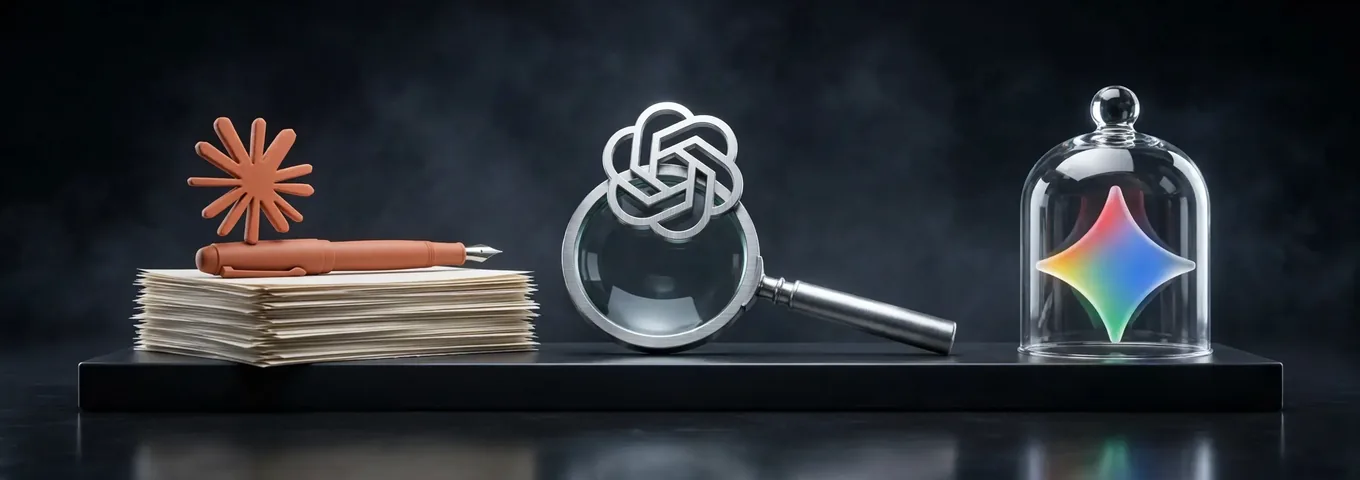
Claude is best for drafting and revising an essay, and GPT is best for finding sources to cite. That split comes from two public leaderboards where people vote blind between two answers, and it's the same split most essays need: good prose and real references.
We read both boards in Arena's public leaderboard dataset on 25 October 2026. The writing board is the Writing, Literature and Language category, published 22 October with style control, so a longer or bolder answer doesn't win on looks. Claude Opus is 1st there. Gemini is 2nd, a near tie: the two scores sit inside each other's margin of error. GPT's best is 13th.
The search board ranks models that answer with web results and citations, 42 of them, published 13 October. GPT is 1st, Claude 4th, and Gemini's best entry 14th. Here are the best writing ranks for each family, from the 22 October board:
| Family | Best model on the writing board | Rank of 417 | Votes |
|---|---|---|---|
| Claude (Anthropic) | Claude Opus 5.5 (High) | 1 | 3,104 |
| Gemini (Google) | Gemini 4 Argon (High) | 2 | 2,914 |
| Muse (Meta) | Muse Wonder (Max) | 4 | 1,771 |
| GPT (OpenAI) | GPT-5.6 Sol (xHigh) | 13 | 11,702 |
| Kimi (Moonshot) | Kimi K3 (Max) | 17 | 9,511 |
| Qwen (Alibaba) | Qwen3.8-Max | 23 | 8,031 |
| Grok (xAI) | Grok 4.5 | 39 | 10,889 |
| DeepSeek | DeepSeek V4.1 Flash (Max) | 43 | 3,655 |
| Mistral | Mistral Medium 3.5 | 121 | 2,993 |
One caveat. Arena voters judge everyday writing prompts, not graded essays, and nobody marks them against a rubric. Use the ranks to pick which two models to try, then let your own draft decide.
Essay apps are a different product. Most essay tool lists push essay writers such as MyEssayWriter, EssayGenius and Textero, and editors such as Grammarly and QuillBot. None of them is a model on Arena's boards, so no public blind vote ranks their drafts. Grammarly and QuillBot do a narrower job. They check and reword sentences you've already written.
Which AI is best for essays with references?
GPT is the best AI for essays with references, because it ranks 1st on Arena's search board, but no chatbot's citations are safe to paste unchecked. Open every source, and confirm the author, year and quote are really there.
Know what that board measures. Its voters judge everyday questions answered from the web, not academic reference lists, and no one checks the cited pages. So it tells you which model searches well. It doesn't tell you which one cites journals accurately.
Paste this to get sources you can check in minutes:
Find five peer reviewed sources on [your topic] published since 2020. For each one, give the full citation, a DOI or a working link, and one sentence quoted from the abstract. If you can't find a real source, write "not found". Don't guess.
The free plans already search the web. OpenAI's pricing page lists search on Free, with "Limited deep research". Anthropic's pricing page lists web search on Claude's free plan too, and keeps its longer Research mode for Pro at $20 a month, or $17 a month billed at $200 a year.
Can teachers tell if you used AI to write an essay?
Sometimes, and no tool can promise they won't. As of October 2026 all three big chatbot makers watermark some of their text, and the watermark sits in the choice of words, not in hidden characters. We checked each maker's own page on 25 October 2026:
| Chatbot | Does it watermark text? | Where, and since when | Who can check for it |
|---|---|---|---|
| Gemini | Yes, with Google's SynthID | Text from the Gemini app and website; Google's page gives no start date | Google's SynthID Detector page describes checks for images, video and audio, not text |
| Claude | Yes | New Claude models, worldwide, per Anthropic's 14 August 2026 post; models launched before 2 August 2026 are being added over the coming months | A detection API in private preview, open to groups such as regulators, media, researchers and educational organizations |
| ChatGPT | In the EU only | Eligible ChatGPT and Codex text in the EU, rolling out from October 2026 | Approved researchers and expert organizations, case by case |
Editing doesn't reliably wash it out. Anthropic's watermark post says "Light editing probably won't remove the watermark completely", though a complete rewrite will. OpenAI's EU provenance post reports that swapping 10% of words for synonyms cut detection from about 92% to 66%, and it warns the other way too: "The absence of a detected watermark does not prove human authorship."
Schools mostly don't read watermarks. They run detectors like Turnitin, and Turnitin has targeted rewording tools since 27 August 2025, when it said its detection capabilities "now include AI bypasser detection" for English. Its model guide logs more English model updates after that, the first on 14 October 2025. So "undetectable" is a promise no essay tool can keep. Turnitin's own guide adds, in a December 2023 entry, that "an AI Writing score should not be used as the sole basis for adverse actions against a student."
Is using AI to write an essay cheating?
Using AI on an essay is cheating when your course's policy says it is, and when a course says nothing, some universities treat AI like a person helping you. Stanford adopted its generative AI guidance on 16 February 2023, and it was still posted when we read it on 25 October 2026. It says: "Absent a clear statement from a course instructor, use of or consultation with generative AI shall be treated analogously to assistance from another person."
Most students already use it. In HEPI's 2026 survey, 94% of 1,054 UK undergraduates used generative AI to help with assessed work. The share who put AI generated text straight into that work rose from 3% in 2024 to 8% in 2025 and 12% in 2026. And 65% said assessment had changed significantly because of AI.
Rules differ by course, even inside one university. Read the syllabus line on AI before you open a chatbot, and ask the instructor when it's vague. That answer is the only one that counts.
How do you use AI on an essay and stay inside the rules?
Use AI to question and check your work, and write the sentences yourself unless your course allows more. These six steps keep you on the safe side of most policies:
- Read the course's AI policy and note what it allows: ideas, outlines, feedback, or drafting.
- Ask for questions, not paragraphs. ChatGPT's study mode runs on every plan; type @study in the message box, and it will "guide you with questions instead of giving the answer right away", per OpenAI's study mode FAQ.
- Find sources with search, then open each one and check the quote is really in it.
- Write the draft yourself.
- Ask for feedback without a rewrite. Paste your draft and the rubric, and ask: "Don't rewrite any sentence. List the three weakest points in my argument, and every claim that needs a source."
- Keep your drafts and chat history, so you can show how the essay grew if anyone asks.
Study mode has one gap for essays. OpenAI's FAQ says it's "not available in Temporary Chats, GPTs, or Projects", so it won't work inside a Project where you keep your course files.
Which AI is best for essay writing for free?
ChatGPT is the best free AI for essay writing. OpenAI's pricing page lists "Unlimited text chats" on Free, subject to abuse guardrails, plus search and study mode. Claude has a free plan as well, and Anthropic lists web search on it too.
You can try both voices on one essay at no cost, in two browser tabs. Whizi, which publishes this page, puts Claude Opus and GPT side by side on its $29.99 Pro plan. Where it loses: its free tier stops at 7 messages on the first day and 3 a day after that, on Whizi AI and Auto only, so the two free tabs win here.
- Read the AI line in your syllabus before you open a chatbot, and ask the instructor if it is vague.
- Draft in Claude or Gemini, which lead Arena's writing board; search for sources in ChatGPT, which leads its search board.
- Open every source a chatbot gives you and confirm the quote is in it.
- Ask for feedback on your own draft without letting the model rewrite it.
- Keep your drafts and chat history until the grade is final.
Frequently asked questions
Can ChatGPT write my essay for me?
ChatGPT can write a full essay draft, but whether you can hand it in is your course's decision. When a course says nothing, Stanford's default treats AI help like help from another person. In HEPI's 2026 survey, 12% of UK undergraduates had put AI text straight into assessed work. Our Claude vs ChatGPT for writing comparison covers which one drafts better.
Are AI humanizers undetectable?
No. Turnitin added detection for AI bypasser tools on 27 August 2025, and OpenAI found that swapping 10% of words for synonyms still left its watermark detectable about 66% of the time. No humanizer maker controls what a school's detector will flag next term. Our guide on how to use AI for writing covers editing that makes a draft your own.
Is Claude Pro worth it for writing essays?
Only if you write long essays every week. Claude's free plan already drafts and searches the web; Pro at $20 a month, or $200 a year, adds the longer Research mode. Our Claude Pro review goes through what the plan adds.
Which AI app is best for students writing essays?
It depends on the job: Claude for drafting, ChatGPT for sources and study mode, and an app that reaches both if you want to compare. Our ranking of the best AI apps for students compares nine apps on essays and research papers, with prices as of October 2026.
